Ometepe
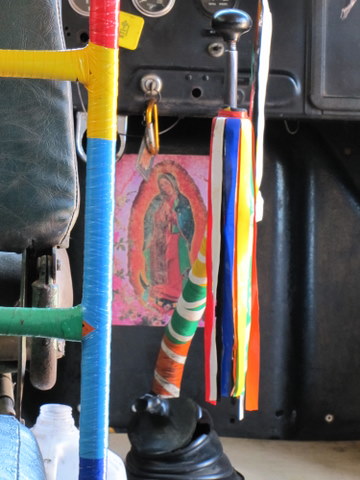 Scruntched into one of the old U.S. yellow school busses that ply the roads of Nicaragua, we make our way from Granada through lush green countryside and small pueblos to Rivas. A recent college grad from Minneapolis offers to share a taxi to the ferry at San Jorge. We let Ben do the negotiating and probably overpay a dollar or two, but we make it to the ferry in time.
We disembark on Election Day Eve at Moyogalpa, the island’s largest city which is about the size of La Cumbre Plaza. Honestly. The place we thought we would stay is not taking guests because… something to do with the election. We wander toward our second choice which is also staffed and also not taking guests. 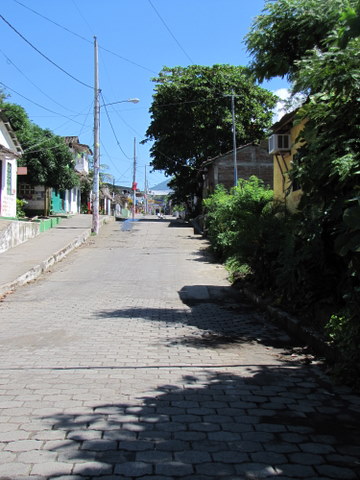 There’s a newish two-story building at the end of the street that is obviously not a typical residence. Xavier, like everyone here, doesn’t try to sell us on anything — at all. We’re the only guests so we have our pick of rooms and choose the large one off the private veranda on the second floor with a view of the volcano. $20.
Click on the photo of the main street at rush hour to see more from Moyogalpa.
Like Riding a Bicycle
We slathered on sunscreen and set out on mountain bikes for the tiny hamlet of San Marcos. We had walked south on a paved road in blazing heat the previous day, so a leisurely ride west on the same road, creating our own wind, seemed like an easy way to explore more of the island, get close to the active volcano and enjoy a little exercise.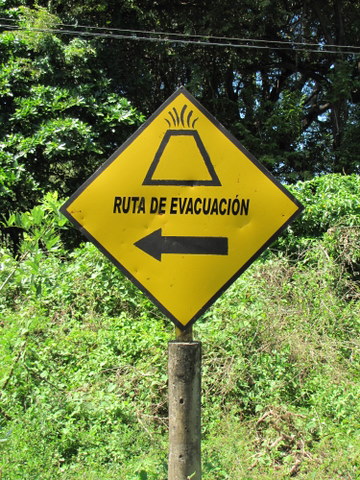
We puffed a bit up the short hill from the ferry landing to the church and then cruised effortlessly for about five minutes until the pavement ended; then the road had a slight incline; then the potholes that were at first easy to negotiate turned into trenches filled with small boulders or disappeared altogether into long stretches of deep, black sand, and we had to compete with several small herds of cattle for the less arduous path; and then just as we felt confident tearing over the rocks and dodging grazing horses, sleeping dogs and yellow caution signs, the road began a steep ascent.
Hours later, when we returned thoroughly jostled but free of road rash, Alan (with cold Diet Coke in hand) turned to me and said, “That was fun.” I agreed.
Arriba! Arriba!
The Volcan Maderas Index
4,574
Altitude in feet of the Maderas volcano
2
Number of your blogging buddies who thought they were
taking a morning hike on the easiest trail
2
Number of your blogging buddies who were
sorely (pun and very heavy emphasis intended) mistaken
7.5
Hours in the air Alan and Harriet spent flying from LAX to Nicaragua
9
Hours spent on Volcan Maderas trek
45
Degrees of average incline on the mountain
4.5
Hours climbing up wet, clay-slicked rocks and mud
before deciding to head back through the very aptly named rainforest
0
Number of injuries incurred
5
Number of people we most appreciate today:
our guide,
Alan’s trainer (Mikki) and Harriet’s coach (Tim)
the guy who maintains the stadium stairs at SB City College,
the orthopod who prescribed Napraxen
25
Minutes it will take to clean our shoes and
pound the mud out of our pants
12
Minutes it will take our clothes to dry on the line
*
Rank in difficulty when compared with any of our other
hikes/treks/climbs, anywhere in the world, any time, any duration, any altitude, any weather, and while in any physical condition:
One
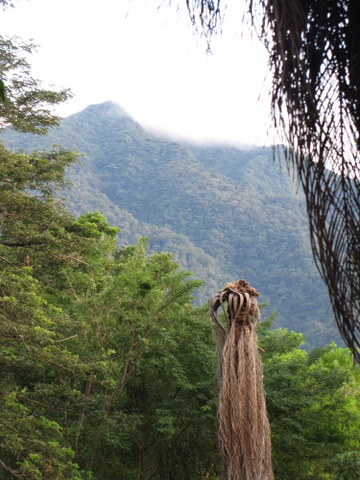
(Click on the photo below to see more from our trek.)
Hotel El Encanto
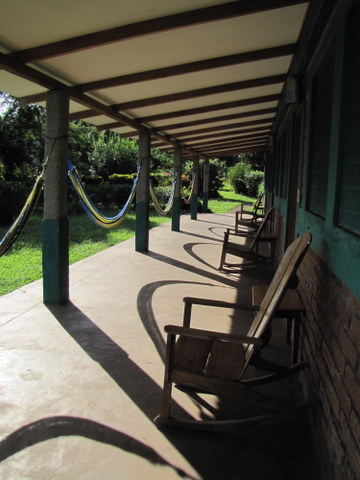 Yup, just like the one on Santa Barbara. Okay, so maybe the room colors lean more toward the primaries than the subdued, but all of them come with a hammock; they are immaculate; the food is some of the best we’ve had in Nicaragua; there’s a view to the water, and depending on which way you choose to snooze in the hammock, a view of Volcan Maderas or Volcan Conception; the garden is much more spectacular than its Santa Barbarian counterpart and it’s filled with hundreds of butterflies, hummingbirds and birds. An added bonus: three very, very sweet dogs.
Carlos, the owner, like everyone with whom we’ve had any interaction, is a sweet, mellow, friendly guy. A native of El Salvador, he lived in Bellingham, Washington for seven years before coming to Nicaragua. Eventually he moved to Isla Ometepe and opened the El Encanto here in Santa Cruz three years ago.
Santa Cruz is not so much a pueblo as it is a dozen hotels, 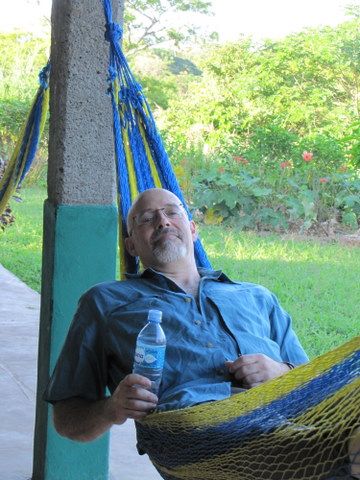 hostels and fincas (farms) spread out over a couple of miles along two unpaved roads. There are lots of horses and pigs grazing alongside –and occasionally in — the road and corn, rice and beans grow easily in the rich, black, volcanic soil. We’ll need to take a 25 minute bus ride to the nearest town with a bank so we have enough cash to pay our tab at the El Encanto and move on to our next destination. The bus ride will be easy; leaving this little gem will not.
Click on the photo above to see more photos from the El Encanto, Santa Cruz and life on Isla Ometepe.


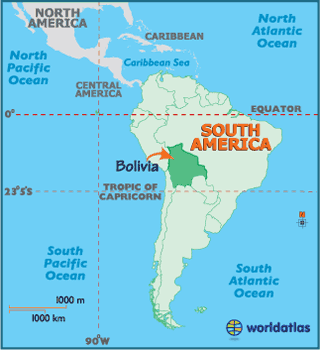 After much hesitation and uncertainty, we finally bought our tickets to La Paz, Bolivia. We’re leaving Nov 2 and returning Nov 20, in time for our annual Thanksgiving party. Once we got our Rough Guide and could see photos and itineraries, we really started to get excited.
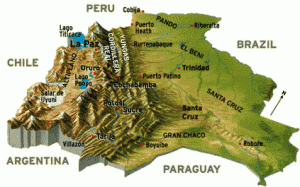 Bolivia is landlocked and spans both Andean highlands and Amazon lowlands. It’s geography is varied, it contains the ruins of Inca cities, it has the largest percentage of indigenous population, and proudly displays bright colors. The food looks interesting, bowlers are worn by women, and they make chocolate (as in grow the stuff!); what’s not to love?